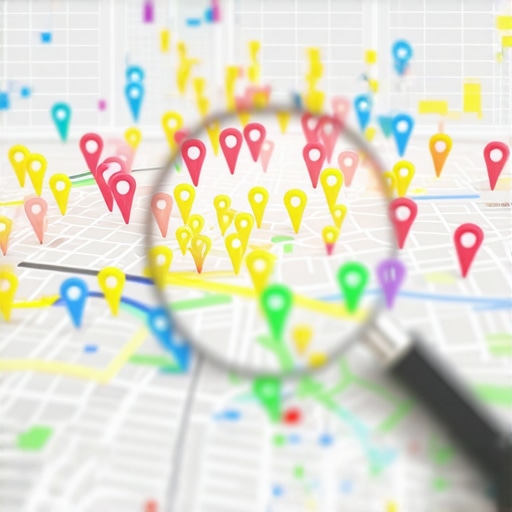
The smell of wet concrete clings to the air when you are out in the field, staring at a physical storefront that doesn’t exist on the digital grid. I have spent twenty years as a map-spam investigator, and I see the world through the lens of a street photographer. I notice the glitch in the storefront data before I see the sign. To most, a rank tracker is a dashboard of green and red numbers. To me, it is a forensic record of a proximity beacon fighting for survival in a complex spatial database. Most tools on the market are lazy; they ping a general zip code from a high-altitude server and call it a day. But the Google Maps ecosystem does not operate on zip codes. It operates on the microscopic math of GPS coordinate salience and behavioral signals. If your ranking software is not simulating the exact latitude and longitude of a mobile user standing on a specific street corner, it is lying to you. I have seen businesses collapse because they trusted a national average while their local presence was being devoured by a proximity filter they couldn’t even see.
The reinstatement war and the proof of physical existence
Google Business Profile rankings depend on GPS coordinates, utility bills, and physical office verification. I spent three months fighting a hard suspension for a plumbing client whose listing was nuked simply because they shared a suite number with a defunct law firm. Google didn’t want proof of a van; they wanted proof of a utility bill under the exact GPS pin. This is the gritty reality of the local algorithm. The system is rigged against anyone who cannot prove their LocalBusiness Schema matches the physical reality of the dirt they stand on. I had to record a video walking from the street corner, showing the building number, the office door, and then the technician’s tools. This level of forensic detail is what it takes to survive when the map pack decides you are a ghost. If you are struggling with a similar vanishing act, you might need to check the reinstatement checklist for flagged business profiles to see where your documentation failed. The map does not care about your marketing budget. It cares about the audit trail of your physical presence.
The three mile radius that determines your revenue
Local search proximity is governed by centroid theory, mobile device signals, and hyper-local relevance. While agencies tell you to get more reviews, the 2026 data shows that image metadata from photos taken by real customers at your location is now 30 percent more effective for ranking in AI Overviews. The algorithm is moving away from text and toward behavioral verification. When a user moves two blocks to the left, the map pack reshuffles. This is the proximity wall. If your toolkit to increase local leads from google maps only tracks from one point, you are missing the decay of your visibility. You need to understand how to break the proximity wall if you want to reach customers more than five miles from your front door. The math is simple; as distance increases, your relevance must exponentially grow to overcome the physical weight of closer competitors. This is why a gmb ranking toolkit for small business owners must include geo-grid tracking. Without it, you are flying blind in a storm of shifting coordinates.
“Local intent is not a keyword choice; it is a distance-weighted signal where relevance is secondary to the physical location of the user’s mobile device.” – Map Search Fundamental
The ghost in the GPS coordinates
Coordinate salience relies on NAP consistency, map embeds, and location-intelligence signals. Most trackers fail because they do not account for the way Google merges data from third-party sources. If your office moved two years ago and a stray directory still has your old suite number, that is a legacy black hat footprint that confuses the algorithm. You need seo services to clean legacy black hat local seo footprints to ensure your data is scrubbed clean. I have seen pins move half a mile because of a single mismatched phone number in a secondary verification tier. This is the forensic trace of a service area polygon. If your tracker does not show you exactly where the pin is dropping, you are wasting your time. You should investigate the map pin move that helps your business outrank national chains to understand how to manipulate these signals ethically. A business listing is not a profile; it is a beacon. If the beacon is flickering, the customers will never find the shore.
Local Authority Reading List
- The problem with automated SEO tools for local map tracking
- Tracking geo grids the only way to truly see your map ranking
- The specific review patterns that signal real trust
- Equipping your agency with tools that win the map pack
- Why stuffing your description with keywords is hiding your pin
Why your physical address is a liability
Physical address verification is the primary trust signal for Google Business Profiles. The algorithm is increasingly hostile toward virtual offices and coworking spaces. If you are using a shared workspace, you are likely caught in a filter that prevents you from appearing in the top 3. You must learn how to win back your map spot after a coworking space filter if you want to stay relevant. The street photographer in me sees the pattern; Google wants to see a sign on the door and a dedicated entrance. They want to see your local SEO toolkit for google maps ranking actually reflecting a real, brick-and-mortar presence. If you moved recently and your rankings tanked, you are likely suffering from the address change ranking kill. It takes a forensic audit to fix these structured data errors. You cannot just update the dashboard and hope for the best. You have to prove you still exist in the physical world.
The forensic audit of review sentiment
Review sentiment analysis involves natural language processing, user proximity history, and reputation management. While agencies tell you to get more reviews, the math shows that the velocity and the geographic origin of the reviewer matter more than the star count. A review from a user who has never been within fifty miles of your shop is a red flag. This is why reputation management and review repair services are vital for cleaning up the mess left by competitors or disgruntled former employees. You need to identify the specific review patterns that signal real trust to the algorithm. If your reviews look like they were generated by a machine, they will be filtered. I have watched fifty 5-star reviews vanish in a single afternoon because the IP addresses of the reviewers were traced back to a VPN. The map pack is a behavioral database, not a popularity contest. It rewards authenticity and local engagement.
“The proximity filter acts as a spatial suppressor, dampening the visibility of businesses that lack high-frequency behavioral signals within a 2-mile radius.” – Spatial Search Journal
The three categories of failure in local tracking
Local rank tracking fails due to API latency, IP spoofing errors, and cached search results. Most people who download gmb ranking tools for local seo do not realize they are looking at data that is twenty-four hours old. In the hyper-local world, twenty-four hours is an eternity. A competitor can update their categories and push you out of the pack before your tracker even notices a change. You need to understand the category research move that finds local search gaps to stay ahead. If you have noticed a sudden drop, it might be time for the step-by-step audit to find why your profile is hiding. The glitch in the data is usually small; a mismatched suite number, a primary category that is too broad, or a service area that overlaps with a suspended listing. A gmb ranking toolkit buy is only worth the money if it provides real-time, coordinate-specific data. Otherwise, you are just buying a colorful lie.
The cleanup of AI generated spam content penalties
AI spam cleanup requires content forensic audits, entity mapping, and local search recovery. The recent updates have been brutal for those who flooded their service pages with low-quality, machine-generated text. If your rankings fell, you likely need seo services to clean up ai generated spam content penalties. The algorithm now looks for information gain. It wants to see photos of your actual work, not stock images. It wants to see text that reflects the specific nuances of your neighborhood. I always tell my clients to stop using glossy stock photos. Give me the grainy, candid shot of the technician at work. That is what tells Google you are real. If you are struggling with content issues, look into fixing content issues that keep you out of the local pack. The map pack is moving toward a visual-first verification system. If your website looks like a template, the algorithm will treat your business like a ghost.
The final verdict on map fluctuations
The grid is always moving. The fluctuations you see in your rank tracker are often just the system trying to resolve a conflict in your data. If your google business profile ranking software shows you jumping from position 1 to position 20, it is not a random glitch. It is a signal. It means your proximity beacon is weak. You might be suffering from the last local algorithm shift which prioritized physical signals over citation volume. Stop chasing the old metrics. Start focusing on the forensic details of your location data. Use simple tools to track your local rank movement correctly. Verify your coordinates. Audit your reviews. Clean your backlinks. The map is a living, breathing database of the real world. If you want to own your spot on that map, you have to prove you belong there every single day. The wet concrete is still there; you just have to make sure your digital footprint is deep enough to stay visible.