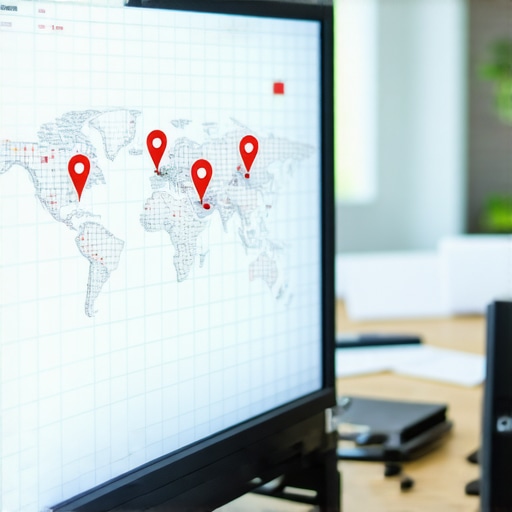
The air in my office usually smells of peppermint and the heavy scent of old paper folders. I keep physical records because digital data is often a lie told by a machine that does not understand the difference between a parking lot and a storefront. Most software today claims to track your rankings, but it misses the grit of the street. I remember fighting a hard suspension for a plumbing client whose listing was nuked simply because they shared a suite number with a defunct law firm. Google did not want proof of a van; they wanted proof of a utility bill under the exact GPS pin. That is a level of forensic reality no automated tool can capture. National chains move into our towns and use software to pretend they have a local soul. They do not. They have a script. I spend my days protecting the merchants who actually have grease on their hands and dirt under their fingernails.
The failure of the digital grid
Automated SEO tools fail because they rely on static pings from data centers rather than the fluid, distance-weighted signals emitted by actual mobile devices moving through a physical neighborhood. These tools lack the spatial intelligence to detect how proximity walls and local filters shift during peak traffic hours. Software usually checks a rank from a fixed coordinate. It does not see how a 3-mile radius shift changes everything for a service provider. If you want to see how the algorithm really treats your presence, you need to look at how to use simple tools to track your local rank movement instead of relying on a dashboard that updates once a week. The map is alive. It is a breathing database of human movement. When a tool tells you that you are number one, it might only be true for the five feet surrounding your desk. Step outside, walk two blocks toward a competitor, and watch the pin vanish. This is why many business owners are confused when the phone stops ringing despite the green numbers on their automated reports.
The proximity wall that software misses
The proximity wall is a mathematical barrier where Google relevance scores drop off sharply based on the user physical location relative to the business centroid. Automated tools cannot simulate the behavioral zooming required to understand why a profile ranks at noon but disappears at five in the evening. This happens because the algorithm adjusts for intent. A person searching for a cafe at 8 AM has different proximity expectations than someone looking for an emergency plumber at midnight. Many agencies sell local seo services to fix nap inconsistencies as a silver bullet, but if your proximity signals are weak, consistent naming will not save you. You have to understand the physics of the map pack. The grid is not flat. It is warped by the density of competitors and the historical traffic patterns of your city. If you find your business is hidden, you might need to look into the step-by-step audit to find why your profile is hiding to see if you have hit a filter you did not even know existed.
“Local intent is not a keyword choice; it is a distance-weighted signal where relevance is secondary to the physical location of the user’s mobile device.” – Map Search Fundamental
The myth of the automated citation blast
Automated citation blasts often create more harm than good by polluting the local ecosystem with low-quality data that triggers spam filters and erodes the trust signals Google requires. High-quality local SEO requires manual verification of niche-relevant mentions on neighborhood sites that machines cannot easily access or scrape. I see this constantly. A business owner pays for a blast of two hundred directories. Suddenly, their data is everywhere, but it is slightly wrong. Maybe the suite number is missing. Maybe the phone number has a tracking extension. This creates a mess that requires the manual cleanup tweak that fixes broken citation data to resolve. Computers love patterns. When a computer sees a sudden burst of identical data across two hundred dead websites, it does not see authority. It sees a footprint. It sees an attempt to game the system. Real authority comes from why mentions on local neighborhood sites carry more weight than directory citations because those links are harder to get and reflect a genuine community presence.
Local Authority Reading List
- The Proximity Reset and Reclaiming Rankings
- Fixing Rankings After a Business Move
- The Virtual Office Ranking Sabotage
- The Ranking Analysis Routine for Owners
- The Map Embed Move for Algorithm Proof
The behavioral zoom into customer photo metadata
Customer photo metadata is a hidden ranking signal that provides Google with undeniable proof of a physical visit through embedded GPS coordinates and timestamped EXIF data. While automated tools focus on text reviews, the 2026 data shows that authentic imagery is now more influential. Think about the street photographer. They capture the raw reality of a storefront. When a customer takes a photo inside your shop, that file contains data. It tells Google exactly where the person was standing. This is far more powerful than a written review that could have been faked from a VPN in another country. If you are struggling, you should investigate the specific photo edits that force google to show your hidden business profile. A machine cannot simulate a real human taking a real photo. This is why I tell my clients to stop worrying about the quantity of stars and start worrying about the quality of the visual evidence. Google uses this data to verify that your office is more than just a P.O. Box. If you use a fake address, you are likely to get caught by how to reclaims leads lost to competitors using fake addresses.
Why local categories are too complex for bots
Selecting the correct primary and secondary categories requires a nuanced understanding of local search volume and competitor density that automated tools cannot replicate with simple keyword matching. The wrong category choice can trigger a hidden filter that excludes your business from the most relevant map packs. Most people just pick the first thing that looks right. They do not realize that the hierarchy of categories is a complex tree. If you are a lawyer, do you pick ‘Law Firm’ or ‘Personal Injury Attorney’? The answer depends on what everyone else in a two-mile radius is doing. You need to use the category research move that finds local search gaps to find the path of least resistance. Software will just tell you what is popular. It will not tell you where the opportunity lies. I have seen businesses double their call volume just by changing one secondary category. That is not something a bot will suggest because the bot does not understand the local market competition. It only understands the global average.
“Relevance is not a fixed attribute; it is a comparative measure determined by the proximity of the searcher and the category density of the immediate area.” – Vicinity Algorithm Whitepaper
The forensic cleanup of a toxic digital history
Cleaning a toxic digital history involves a manual audit of historical backlinks and citation data to identify and remove the residues of past black-hat SEO tactics that continue to suppress local rankings. Machines cannot distinguish between an accidental naming error and a deliberate attempt to manipulate the map pack. Many owners inherit a mess from a previous agency. They have keyword-stuffed descriptions and a toxic backlink profile that is actively hurting them. You cannot just run a tool and click ‘fix’. You have to go in with a scalpel. You have to look for the patterns of spam that a previous person left behind. This might involve local seo services for cleaning historic citation spam campaigns to restore the trust signals. Google has a long memory. If you tried to cheat the system five years ago, those signals might still be attached to your phone number or your domain. A manual audit is the only way to find the ghosts in the GPS coordinates. You need to identify the errors hiding your business in the map pack before you can start building fresh authority.
The three mile radius that determines your revenue
The three mile radius represents the primary conversion zone where a business maintains the highest proximity authority and the lowest barrier to entry for local consumers. Rankings beyond this circle require aggressive engagement signals and hyper-local content that proves relevance to specific neighborhoods. Most business owners want to rank for the whole city. That is a mistake. You win by dominating your immediate neighborhood first. Once you have a lock on your two-mile radius, you can start breaking the three mile radius and reaching customers five miles out. This is done through localized content, not by adding more keywords to your title. If you stuff your name, you will find out why stuffing your description with keywords is actually hiding your pin. Google wants to see that you are an active part of the community. They want to see reviews that mention specific streets and landmarks. They want to see engagement patterns that reflect real-world local trust. A dashboard cannot build a relationship with your neighbors. Only you can do that by being a real business in a real place.
The struggle of the shared office space
Shared office spaces often lead to ranking suppression because the Google algorithm filters out multiple businesses of the same category operating from a single address to ensure map pack diversity. Proving the existence of a dedicated, permanent office is the only way to bypass these filters. I have seen dozens of great businesses get crushed because they moved into a trendy coworking space. Google sees fifty businesses at one address and gets suspicious. You have to provide how to prove to google your physical office is real evidence. This means a lease, a dedicated entrance, and signage that is not just a piece of paper taped to a door. If you fall into the coworking space mistake, you might find yourself invisible. The map is a database of physical truth. If your truth is shared with ten competitors, the algorithm will pick the one with the strongest historical signals and hide the rest. You need winning back your map spot after a coworking space filter strategies to survive in that environment. It takes more than just a toolkit. It takes a strategy that values the physical over the digital.