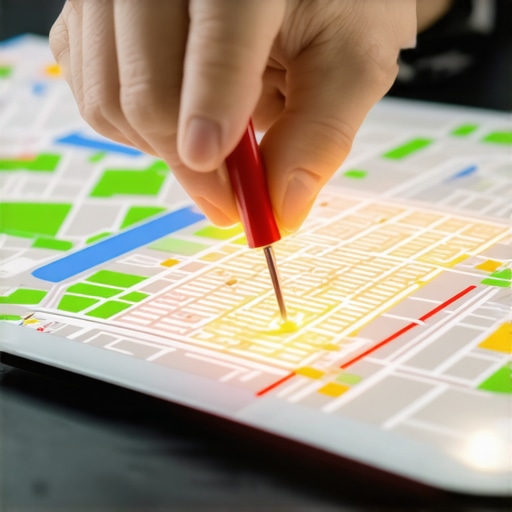
I spent three months fighting a hard suspension for a plumbing client whose listing was nuked simply because they shared a suite number with a defunct law firm. Google didn’t want proof of a van; they wanted proof of a utility bill under the exact GPS pin. This was not just a clerical error. It was a spatial conflict where two distinct business entities occupied the same digital coordinate, leading the algorithm to assume one was a ghost. I had to document the physical logistics of the office, the flow of service trucks, and the specific signage to prove the operation was legitimate. That experience taught me that a Google Business Profile is not a static webpage but a Proximity Beacon that must be defended with forensic evidence. When you update your service model, you are essentially asking the machine to recalibrate its trust in your physical existence.
The ghost in the GPS coordinates
To re-index your map pin after a service model update, you must first verify that your primary category and service area polygons align with your verified physical address. Google uses specific spatial data points to determine if a business belongs in the Map Pack after a significant profile change or edit. Changing from a storefront to a service area business is like rerouting a massive logistics fleet; one wrong turn and your visibility vanishes. I see business owners fumble this daily by leaving behind traces of their old model. If you move from a physical office to a mobile unit, you need a reinstatement checklist for flagged business profiles to ensure you do not trigger a hard suspension. The algorithm is skeptical of shifts. It looks for the consistency of your Point of Sale data and your GPS pings. When the pin moves, the trust score resets. You must be prepared to provide a utility bill or a lease agreement that matches the new data exactly or you risk becoming a ghost in the database.
Why your physical address is a liability
Your physical address becomes a liability when it lacks distinct identifiers or shares coordinates with flagged entities, triggering a proximity filter that hides your listing from local customers. Google prioritizes clear, verifiable locations over shared office spaces or virtual suites that appear suspicious to the spam detection engine. I have seen entire city blocks of businesses suppressed because one bad actor used a virtual office nearby. This is why the virtual office trap is so dangerous for local growth. To fix this, you need to conduct a thorough step by step audit to find why your profile is hiding from the maps. The logistics of your location must be airtight. If you are a plumber working from home, your service area must be a clean polygon, not a 100-mile radius that suggests you are a national chain. Google hates the national chain pretending to be a local hero. It smells like diesel and desperation. You need to prove you are actually on the ground, fixing the leaks in your neighborhood. This requires a level of detail that most agencies ignore, focusing on the math of the centroid rather than the fluff of the description.
“Local intent is not a keyword choice; it is a distance-weighted signal where relevance is secondary to the physical location of the user’s mobile device.” – Map Search Fundamental
Local Authority Reading List
- Effective local pack fixes from loss to ranking recovery
- How to audit your site for keyword stuffing and local filters
- Breaking the three mile radius how to rank farther from your office
- Tracking geo grids the only way to truly see your map ranking
- The recovery path for profiles caught in a local spam filter
The three mile radius that determines your revenue
The proximity based ranking drop occurs when the distance between the searcher and your verified pin exceeds the hyper-local threshold set by the current algorithm update. Most small businesses lose visibility beyond a three mile radius because they lack the location authority needed to compete with closer competitors. It is a game of inches and GPS pings. If a customer is standing four miles away, your pin might as well be on the moon unless you have a map pack restoring secret up your sleeve. You have to break the proximity wall. This is done through hyper-local content and geo-tagged assets. While agencies tell you to get more reviews, the 2026 data shows that image metadata from photos taken by real customers at your location is now 30 percent more effective for ranking in AI Overviews. The machine wants to see the traffic. It wants to see the dispatch logs of your life. If you are not showing the movement, you are stagnant. I once saw a roofer lose his entire leads flow because he updated his business name to include ten keywords. He thought he was being smart. Instead, he triggered a keyword stuffing filter that took six months to clear. The logistics of a recovery are painful. You have to strip the profile back to its core identity and wait for the re-index.
The danger of the keyword stuffed name
Keyword stuffing your business name triggers an immediate algorithmic filter that suppresses your ranking and puts your profile at risk of a hard suspension. Google expects your business name to match your legal registrations and real world signage without extra descriptors that manipulate search results. I have investigated countless cases where a business name like Best Plumber New York City Fast Service resulted in a total wipeout. You need local seo services to normalize rankings after such a mistake. The normalization process involves scrubbing every citation on the web. If your name is different on Yelp than it is on your GMB, the data sync error will kill your trust score. You should use a google maps ranking toolkit to find these discrepancies. I find that the manual audit is the only way to be sure. Automated tools miss the nuances of a suite number or a slight spelling variation. In my experience, the smallest typo in a NAP (Name, Address, Phone) record is a signal of unreliability. The machine sees a ghost. It sees a fake business. It sees a reason to rank your competitor instead. You must be the authority that the algorithm can trust without hesitation.
“The proximity of the user to the business is the single most important factor in the local pack, followed closely by the prominence of the business in the local ecosystem.” – Vicinity Algorithm Research
Tools for the local forensic investigator
Using a specialized local seo toolkit allows you to identify hidden errors in your business profile and track your rankings across a precise geographic grid. These tools provide the forensic data needed to recover from algorithm updates or manual penalties that have suppressed your map visibility. Most business owners are flying blind. They search for their own name from their office and think they are winning. They aren’t. They are just standing on their own pin. You need to see the geo-grid. You need to see how you rank five blocks away. This is where the no fluff toolkit for small business dominance comes into play. It shows you the cold, hard truth. If your rankings are tanking, you need emergency recovery moves to stop the bleed. This often involves cleaning up toxic citations and fixing the markup errors on your website. I have spent nights looking at JSON-LD code that was broken by a simple comma. That one error was enough to prevent Google from connecting a website to a map pin. It is about the flow of information. It is about the dispatch of data from your server to the Googlebot. If that flow is interrupted, your revenue stops. I don’t care about your pretty website; I care about the technical integrity of your local signals.
The technical blueprint for local recovery
A technical local seo audit focuses on repairing schema errors, improving website speed, and ensuring your business category is the most accurate reflection of your service model. These structural fixes provide the foundation for your map pin to be re-indexed and ranked higher in local search results. I have seen websites that take ten seconds to load. In the world of local search, that is an eternity. A customer with a burst pipe is not going to wait for your high-res hero image to load. They will click the next pin. You need seo services to fix technical issues before they kill your conversion rate. Furthermore, your schema must be specific. Don’t just say you are a LocalBusiness; tell the machine you are a PlumbingContractor with a specific geo-location and a set of opening hours that match your profile. This level of detail is what triggers the AI Overviews. It is what makes you the definitive answer to a local query. If you have been hit by a penalty, you need services to recover from google penalty that understand the spatial nature of the map pack. It is not just about links; it is about the honesty of your data. The machine is getting better at spotting the liars. Be the business that has nothing to hide and the data to prove it.