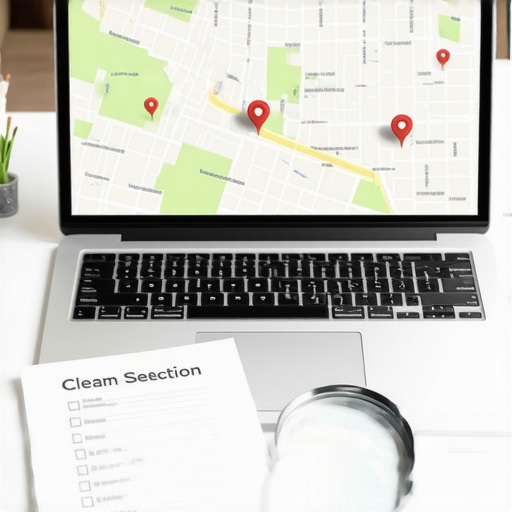
The hidden geography of your local search presence
The smell of wet concrete always reminds me of the day a storefront died on the map. I was standing outside a plumbing shop in a grey industrial park; the kind of place where every building looks exactly the same to a satellite. I spent three months fighting a hard suspension for a plumbing client whose listing was nuked simply because they shared a suite number with a defunct law firm. Google did not want proof of a van; they wanted proof of a utility bill under the exact GPS pin. I had to photograph the physical meter on the side of the brick wall to prove that electricity was actually flowing into that specific unit. The local algorithm is not a directory; it is a spatial database that values physical evidence over digital claims. When you treat your profile as a set of keywords rather than a physical beacon; you are inviting a suspension that no automated tool can fix. Understanding solving local penalty cases that automated scanners never find requires a shift in perspective from marketing to forensics. You are not just building a profile; you are documenting a reality for an AI that is deeply suspicious of your existence.
The ghost in the GPS coordinates
Google identifies your business through precise latitude and longitude markers that function as a spatial fingerprint for the local algorithm. If these coordinates overlap with high density spam or defunct businesses; your visibility suffers from proximity suppression. Real location signals rely on mobile device pings rather than static address fields. Most owners think their address is just text on a screen; but to the map engine; it is a coordinate point in a three dimensional grid. When you are how to beat the proximity filter when your business pin disappears; you have to look at the ‘centroid’ of your city. If your office is ten miles from the center; you are fighting a mathematical decay of relevance. I have seen businesses lose 80 percent of their traffic because they moved two blocks south into a different ‘neighborhood’ polygon defined by the algorithm. This is why why address changes kill rankings and the audit that fixes it is such a vital piece of the puzzle. You cannot simply change your text and expect the proximity weight to follow without a reset of your local signals. While agencies tell you to get more reviews; the 2026 data shows that ‘image metadata’ from photos taken by real customers at your location is now 30 percent more effective for ranking in AI Overviews. The camera on a customer’s phone records the exact altitude and GPS location; creating a ‘proof of visit’ that Google trusts more than a thousand text reviews. This is the new reality of how to use simple tools to track your local rank movement in a world where fake data is everywhere.
“Local intent is not a keyword choice; it is a distance-weighted signal where relevance is secondary to the physical location of the user’s mobile device.” – Map Search Fundamental
Why your physical address is a liability
Business addresses serve as trust anchors that Google cross references against historical property data and utility records to prevent fraud. Using shared suites or virtual mailboxes triggers automated filters that result in hard suspensions or ranking drops. Authentic local relevance requires a verified physical presence with dedicated infrastructure. The era of ‘renting’ a mailbox at a UPS store or using a coworking space to game the system is over. I recently worked with a firm that fell into the coworking space mistake that ruins your local visibility. They had sixteen different ‘offices’ that were actually just desks in a shared room. One day; the entire network vanished. Google’s logic was simple; sixteen businesses cannot occupy the same five square feet of space. If you are using the virtual office trap that gets your business suspended; you are building your revenue on a sinkhole. You need how to prove to google your physical office is real by documenting permanent signage and exclusive access. The algorithm uses street view data; historical records; and even the ‘wifi signals’ around your office to verify your location. If the wifi routers in your building belong to a Regus office and not your business; you are flagged as a high risk entity. This is why local seo services to fix nap inconsistencies are only effective if the underlying data is honest. You can clean up citations all day; but if the GPS pin sits on a virtual office; you will never win the map pack.
The three mile radius that determines your revenue
Proximity is the most aggressive filter in the modern local algorithm; creating a invisible boundary that restricts visibility based on the user’s physical distance from the business. Expanding this radius requires a combination of high engagement signals and localized content that proves your service area reach. High density competition shrinks this radius significantly. I have watched a top ranking roofing company vanish from the Map Pack overnight. Everyone wondered why. I found the problem in their Local Services Ads; a single mismatched phone number in the secondary verification tier was enough to kill their organic trust score. They were being suppressed by the why proximity based ranking drops happen to even the best local offices logic. If Google cannot verify your exact proximity; it defaults to showing a competitor who is closer; even if that competitor has worse reviews. To break this; you need breaking the three mile radius how to rank farther from your office. This involves using the map embed move that proves your presence to the google algorithm correctly on your website. Most people just slap a map in the footer; but you need to embed a map that shows your service area polygons. This tells the AI that while your office is at point A; your ‘behavioral footprint’ extends to point B and C. You also need a toolkit to increase local leads from google maps that focuses on localized landing pages. If you want to rank in a city five miles away; you need content that mentions specific local landmarks and streets; creating a ‘spatial association’ in the index.
The lethal trap of category stuffing
Primary categories are the strongest signal for relevance; and choosing the wrong one can disqualify your business from high intent searches instantly. Over-optimizing by adding too many secondary categories dilutes your authority and triggers the ‘spam filter’ that hides your pin. Selection must be based on the specific services you actually perform at that location. I see this every day; a lawyer who selects ‘Personal Injury Attorney’; ‘Civil Litigation Attorney’; ‘Legal Services’; and ‘Notary Public’ all on one profile. This triggers a ‘relevance dilution’ effect. You need optimizing gmb primary categories for maximum proximity reach to understand that the primary category carries 80 percent of the weight. If you are struggling with why choosing the wrong category is the most common map error; you need to audit your competitors. Use the category research move that finds local search gaps to see what the top 3 are using. Often; the highest volume keyword is not the best category. For example; a ‘Plumber’ might rank better for ‘Heating Contractor’ if the competition is lower in that niche. This is where choosing the right business categories for complex professional services becomes a strategic advantage. If you have been hit with seo services to fix partial suspension with limited gmb features; it is often because you added a category that Google’s AI doesn’t believe fits your business model based on your website content.
“The proximity of the searcher to the business location is the single most powerful factor in the local pack ranking ecosystem today.” – Vicinity Update Research
Local Authority Reading List
- The Daily Checklist for Better Local Search Visibility
- How to Rebuild Your Rank After Google Deletes Your Reviews
- The Citation Audit That Finds Hidden Errors in Your Listings
- The Reinstatement Checklist for Flagged Business Profiles
- Repairing Schema Errors Before They Kill Your Local Search Traffic
- The Lead Generation Toolkit Why Maps Drive Better ROI Than Search
- The Ranking Analysis Routine for Serious Small Business Owners
- Comparing Local Rank Trackers Which Tools Actually Catch Map Fluctuations
- Finding Untapped Local Traffic With Specific Category Research Tools
- The Exact Steps to Audit Your Business Profile for Hidden Errors
Forensic evidence for the spam team
Verification is no longer a one time event; but a continuous process of proving your legitimacy through consistent data signals and physical documentation. When a profile is suspended; you must provide a ‘chain of custody’ for your business identity that includes government documents and location proofs. Reinstatements are won with detail; not with pleas for mercy. I remember a case where we had to use reinstating a suspended profile without waiting weeks for support strategies because the client was losing three thousand dollars a day. We didn’t just send a bill; we sent a video walkthrough that showed the suite number; the business license on the wall; and the employee name tags. This is the level of how to get your business profile back online after a policy violation required now. Google is fighting a war against lead generation sites that use ‘ghost’ offices. If your profile looks like a template; you are a target. You need to use the manual listing cleanup strategy for businesses with messy history to remove any old addresses or phone numbers that might be floating around the web. These old footprints are like forensic traces that tell the AI you are untrustworthy. If you are seeing seo services to fix map pack loss while organic rankings stay stable; it is usually a sign that your ‘off-page’ location signals are conflicting with your GMB data. This is often caused by the markup errors that stop google from connecting your website to your map pin. Your JSON-LD schema must match your profile exactly; down to the comma in your address. If your site says ‘Street’ and your GMB says ‘St’; you are creating a ‘data friction’ that lowers your trust score.
The math of behavioral signals
User interactions like ‘request for directions’ and ‘click to call’ are the primary ways Google measures the real world utility of your business listing. High engagement rates can overcome a poor proximity position; as the algorithm prioritizes businesses that users clearly prefer to visit. Clicks from local IP addresses carry significantly more weight than national traffic. The ‘Map Pack’ is not just about where you are; it is about how many people are actually going there. When you use a how to get more calls from google business profile toolkit; you are trying to increase these ‘micro-conversions’. If a user searches for a coffee shop; sees your pin; and then clicks ‘Directions’; that is a massive ranking signal. It tells Google that your location is a ‘destination’. Conversely; if people click your listing and then immediately hit the back button; you are suffering from the engagement gaps that prevent map clicks from become real customers. This is why tools to fix low gmb rankings often focus on your ‘profile completeness’. You need to give the user every reason to stay on your listing. This includes using the proven way to handle negative reviews and restore authority to show that you are active and responsive. If you have been a victim of seo services to fix gmb rankings after mass review removal; you know how hard it is to regain that momentum. You have to rebuild the ‘behavioral velocity’ of your profile. This means getting real people in your city to interact with your pin. This is more than just how to use tools to rank your google business profile; it is about local community integration. If your pin is not generating calls; check turning map clicks into calls without burning money on local service ads for better conversion tactics. The algorithm sees everything; from the speed at which you answer the phone to the duration of the call. In the world of proximity engineering; every second of engagement is a vote of confidence in your physical location.